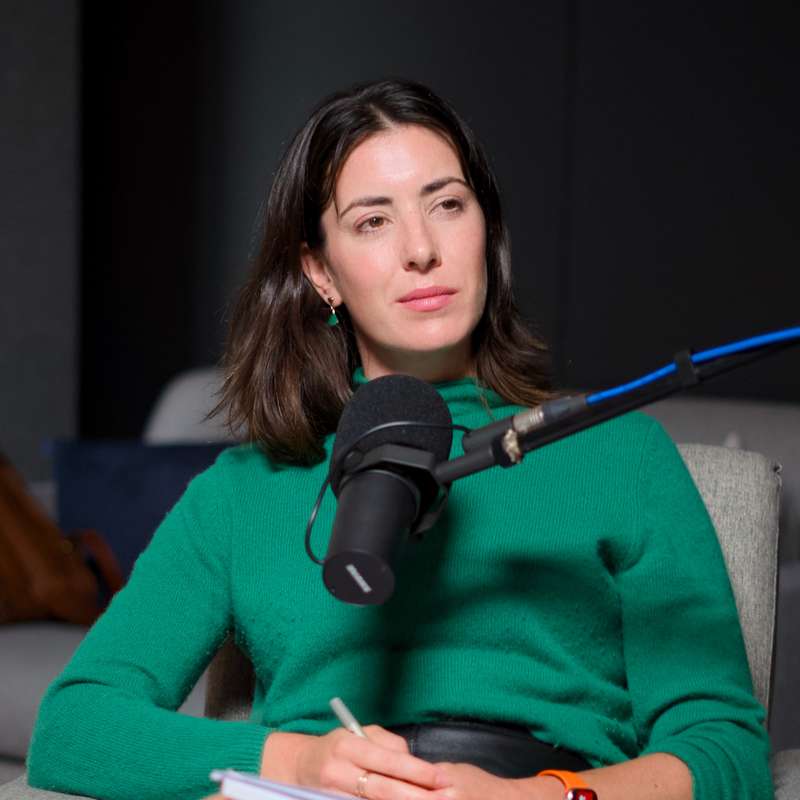
Susannah de Jager
What does it mean to be human in an age of artificial intelligence? And what are we unwilling to automate away? Across this Ethics and Innovation Miniseries, I've spoken to philosophers, technologists, lawyers, policymakers, and social innovators about AI and innovation. Technologies that could transform almost every part of our lives, whether or not we consider ourselves technically minded.
That matters because debates about AI can often feel as though they belong only to engineers, developers and specialists, yet the consequences will affect all of us, our work, healthcare, education, relationships, communities, democracy, and access to justice.
One of the purposes of this miniseries has been to open up these debates and give laypeople, such as myself, a greater sense of agency. We may not all build AI systems, but we all have a stake in deciding how they are used, what values they reflect, and what we want them to protect.
Audrey Tang showed us how technology and innovation can strengthen democracy and collective intelligence rather than concentrate power.
Audrey Tang
I think people were collectively tired of the peak slop. So across the world, we're seeing people's time, engagement with their screen, are all going down. And so in this climate, it is perhaps not the best idea to continue with this engagement baiting, rage baiting algorithm, because people are already being turned off by it.
Susannah de Jager
Raphaël Millière and Edward Harcourt asked deeper questions about intelligence, language, agency, and the human values we may fail to notice until technology begins to challenge them.
Raphaël Millière
You can see infants, for example, babies trying to grab their feet and figuring out what's part of me, what's part of the external world. All of this is happening before infants can speak. So for a baby, it's only later in life that you start speaking and you start externalising your feelings and your thoughts in language and for AI systems, as we have them today, they start with the language.
Edward Harcourt
My gut feeling is that we do need human contact. That is something that we thrive on. The co-presence of another human is special to us and we're hardwired to see things that way.
Susannah de Jager
Caroline Green explored the boundary between AI-enabled care and the human relationships that can make care meaningful.
Caroline Green
We are relational beings. We need each other. We need community. We actually know through so many studies from around the world of what it is to help us age in a way that we are happy and healthy. Technology and AI can always only be part of that.
Susannah de Jager
Lord Lionel Tarassenko considered how AI can improve healthcare while warning that literacy, resilience, and democratic oversight must keep pace with technical capability.
Lionel Tarassenko
There are plenty of AI for good applications and that's what I've devoted most of my career to in the last decade or so on AI for healthcare and there's some amazing work going on in early detection of cancer, for example, in trying to identify certain patterns in your healthcare data that a doctor might not be able to pick up.
Susannah de Jager
Anne Trefethen explained why institutions can no longer make fixed plans for a technology developing at extraordinary speed.
Anne Trefethen
So we had to step back and begin to think about how do we approach this in a world with AI? What are the right investments to be making? And having invested in some of these areas, it does take a bit of courage to say, "No, let's stop. Let's rethink."
Susannah de Jager
But this was never simply a miniseries just about risk. Philippa Webb showed us how legal technology can bring protection within reach of people effectively excluded from the justice system.
Philippa Webb
Only 10% of people who need a lawyer globally can access one and obviously that's an even smaller percentage if you look at vulnerable communities, if you look at women, if you look at global south countries. And we thought, what if technology in particular AI could play a role in trying to close that gap?
Susannah de Jager
Juan Lavista Ferres demonstrated how Microsoft's AI for Good Lab can find patterns beyond unaided human capability from investigating sudden infant death to tackling challenges in health, climate, and disaster response.
Juan M Lavista Ferres
You have a big image, whether that's a satellite image or a CT scan that looks like an image to us, and what you need to do is find a pattern in that image, whether that's a house that was destroyed or something that is different in your pancreas. For us, from a machine learning perspective, from an AI perspective, these problems are basically the same problem.
Susannah de Jager
Jeremy Long and Olga Kozlova brought us back to who benefits from innovation, whether it creates opportunity throughout society or merely concentrates wealth in already successful places.
Jeremy Long
I mean, I think there is a deficit of aspiration in an area where actually youngsters have the opportunity to look at some of the most exciting job opportunities and career opportunities that there could be.
Olga Kozlova
When we talk about successes of our companies such as OrganOx, for example, you would talk about the billion and a half exit and being used in various countries essentially. We only secondarily tell that it saves 10,000 lives.
Susannah de Jager
The thread connecting every conversation was this, AI is neither inherently ethical nor inevitably harmful. Its effects will depend on the choices we make now, what we automate, what we govern, and what we deliberately protect. Just yesterday as I record this, Bill Gates argued in his essay that the choices we make about AI now are critical. AI could become either a powerful equaliser or a source of profound injustice. This is why we need public debate, effective governance, and a clear understanding of which parts of life should remain human-led.
We should not assume that decisions about AI belong only to those who design it. Communities, workers, families, patients, citizens, and consumers all have the right and the responsibility to advocate for what they want to preserve about being human and about living together. The goal cannot simply be more capable machines. It must be more capable, more equitable, and a more human society, and one in which all of us have a voice in shaping the innovation that will define our future.
If these issues interest you, listen to the whole miniseries Ethics and Innovation by Oxford Plus wherever you get your podcasts.
Thank you for listening to this episode of Oxford Plus, hosted by me, Susannah de Jager. If you want to keep up with all things Oxford Plus, visit our website, oxfordplus.co.uk or sign up for our newsletter on Substack.
Oxford Plus is a podcast produced by Story 94.

 Susannah de JagerHost
 Matt Eastland-JonesProducer
 Story Ninety-FourProduction Company
 mishcon.com
 oxfordequinox.com